The green transition of shipping is not a new thing. As early as 1997, the International Maritime Organization (IMO) began a discussion on reducing carbon dioxide emissions from shipping. The first regulation regulating the energy consumption of new ships, called EEDI, came into force in 2011. Since then, the IMO’s regulations for reducing greenhouse gases have become increasingly strict.
Last October, the IMO met to decide on global regulations to reduce greenhouse gas emissions from ships. The matter had been negotiated six months earlier and an agreement had been reached, so hopes were high. If implemented, this IMO net-zero framework would have been the world’s first mandatory greenhouse gas reduction regulation for an entire industry, combining mandatory emission limits and greenhouse gas pricing.
To the disappointment of many, the decision did not enter into force at the October meeting. It was decided to postpone the processing of the matter for a year. The background was even aggressive lobbying by major oil-producing countries, such as the United States and Russia, against the decision. It is widely believed in the industry that when the members of the IMO meet again this year to discuss this decision, there will still be no vote and the decision will be postponed for another year or two.
Now there is a lot of discussion in the industry about whether the green transition of shipping has passed. Did Trump and his associates succeed in stopping the entire development? But in fact, the green transition of shipping is doing well.
European Short Sea Shipping
In 2021, the European Commission published the Fit for 55 package, which aims to reduce emissions by 55% by 2030 and achieve climate neutrality at the EU level by 2050. With regard to shipping, the regulations govern, among other things, emissions trading, the carbon content of fuels, the shore power capabilities of ports and the carbon emissions of ship voyages in relation to the transport performance.
These regulations will have a huge impact on intra-European maritime transport, especially on the business of shipping companies and, therefore, on the fleet. And these regulations are valid regardless of the decisions of the IMO. A month ago, Kongsberg Maritime published a study that today, on several European routes, a fully battery-powered RoPax vessel is cheaper than a traditional diesel alternative during its wholw service life. Its total annual cost of ownership is 8 to 15 percent lower and its fixed asset costs are 18 to 27 percent lower, even though the capital expenditure is 20 percent higher than on a conventional vessel. On the other hand, the business model only works on certain routes with short distances, fixed terminals and a high utilisation rate of vessels, as well as the possibility of electric charging in ports.
In our home waters, Helen’s electricity network announced last week its investments of more than half a billion euros in the electricity transmission network to enable it to serve electrifying foreign sea traffic.
Urban and island traffic
Just before Midsummer, my doctoral student Riina Otsason defended her doctoral dissertation on the reduction of carbon emissions from ships at Tallinn University of Technology. His research focused on commuter vessels in urban and archipelago waterways, as well as other vessels that, due to their small size, are not subject to the greenhouse gas regulations of the IMO or the European Union. The study dealt with urban water transport, archipelago commuter vessels, pilot boats and even wing-in-ground vessel solutions.
The background to the study is a situation in which currently regional regulations steer smaller vessels towards low emissions more strictly than IMO or EU regulations. Cities, municipalities and states have their own goals for achieving carbon neutrality. Water transport has a role to play in achieving these regional goals, which is driving urban and archipelago water transport towards electric solutions at a fast pace.
Deep sea traffic
When the development of autonomous shipping began at a rapid pace more than ten years ago, I was sure that the pioneers would be large vessels in ocean traffic. After all, they travel for days on the high seas according to a pre-planned route without the safety threat caused by possible crossing traffic or rocky fairways. There is no need for staff on board to serve passengers either.
As so often, reality has surprised me. For a long time, an autonomous cargo ship has been operating in Norwegian waters practically from one side of the fjord to the other. In Stockholm, you can try out the now autonomous passenger ship. Autonomous waterborne transport has become more common in regional waters rather than in international long-distance maritime transport.
The reason is obvious. The International Maritime Organization (IMO), which governs ocean traffic, has not yet reached an agreement on the regulations for autonomous maritime transport. On the other hand, Norway, Finland, Japan and many other countries are able to regulate more quickly in their own territorial waters, and thus the spearhead of the development of autonomous maritime transport has shifted to coastal and archipelago traffic. Technology has developed and new, more autonomous technology is also being introduced in ocean traffic, e.g. unmanned engine rooms on ships, but fully automatic ocean liners are not yet in sight.
A similar development is taking place in the green transition of maritime transport. As the IMO has not reached an agreement on tightening greenhouse gas emission regulations for maritime transport, the development is now at the forefront in the EU and in short sea shipping, as well as in regional actors. Technological solutions are advancing rapidly and give a financial advantage to pioneers. Ocean traffic is following step by step as technology becomes more advanced and increasingly economical.
Security of supply and geopolitics
Almost every day, we read about the tariffs imposed by Trump, the Russian shadow fleet or the crises in the Strait of Hormuz, all of which are fighting for control of the world’s maritime transport.
In 1970, more than 60% of the world’s maritime transport was oil and gas. At the same time, OPEC, the community of oil-producing countries, had been given significant power in the world. The first lesson we learned about this power and the disadvantages of oil dependence came in the 1970s during the oil crisis – at the end of 1973, crude oil cost five times more than in September of the same year. In Finland, too, oil consumption was restricted, and the indoor temperature was lowered to below 20 degrees, among other things. As a result of the oil crises, the exponential growth of world oil consumption came to a halt.
Today, oil accounts for only 16% of the world’s maritime transport. Although the global economy has roughly doubled since 2010, oil transports have remained at a stable level of about two billion tonnes since 2010. Refined oil shipments have not increased since 2019 either, even though the world has already recovered from the pandemic.
An increasing number of countries are seeking to reduce their dependence on oil from the Middle East, Russia or other major oil-producing countries. The most significant detachment from oil import dependence has been the United States, whose own oil production has increased significantly during this millennium, already exceeding consumption. Similarly, China is constantly reducing its dependence on oil and, among other things, electrifying its car traffic.
The US invasion of Iran this spring has further accelerated the green transition of the global economies. After the war began, the price of oil rose significantly after Iran closed maritime traffic in the Strait of Hormuz. At the time of writing this, ships are able to move again, which has led to a rapid fall in oil prices and even discounts. Oil is flooding the markets, which have already reduced their dependence on oil and no longer want to buy it as they used to. The reliability of oil as a safe and stable source of energy has received another blow.
Finland has a significant amount of self-sufficient energy production, such as nuclear, biopower and hydropower. It is also in Finland’s national security of supply interest to continue to reduce its dependence on fossil fuels and to switch more and more to self-sufficient energy production.
Final remarks
Will it eventually happen that the security of supply perspectives and the development of low-emission maritime technology for shorter distances will eventually make the green transition of shipping so attractive that even ocean traffic will no longer wait for the IMO’s regulations and will give up fossil fuels on its own initiative? Time will tell, but right now we are heading in that direction.
This article was previously published in Anthony Sundström’s Transparent Logistics newsletter on 2.7.2026.
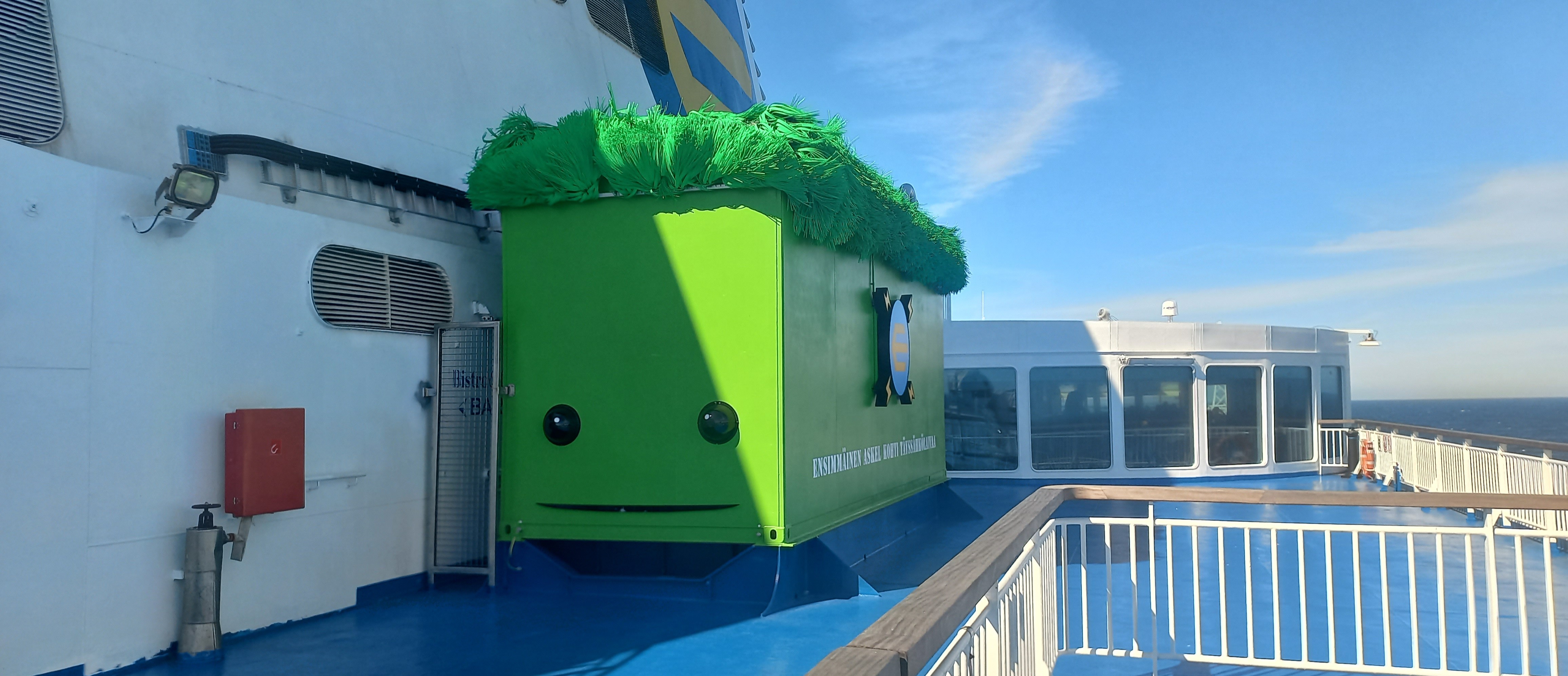
Photo Kristin Kerem ms Finlandia battery back.


One thought on “The green transition of maritime transport, where are we now?”