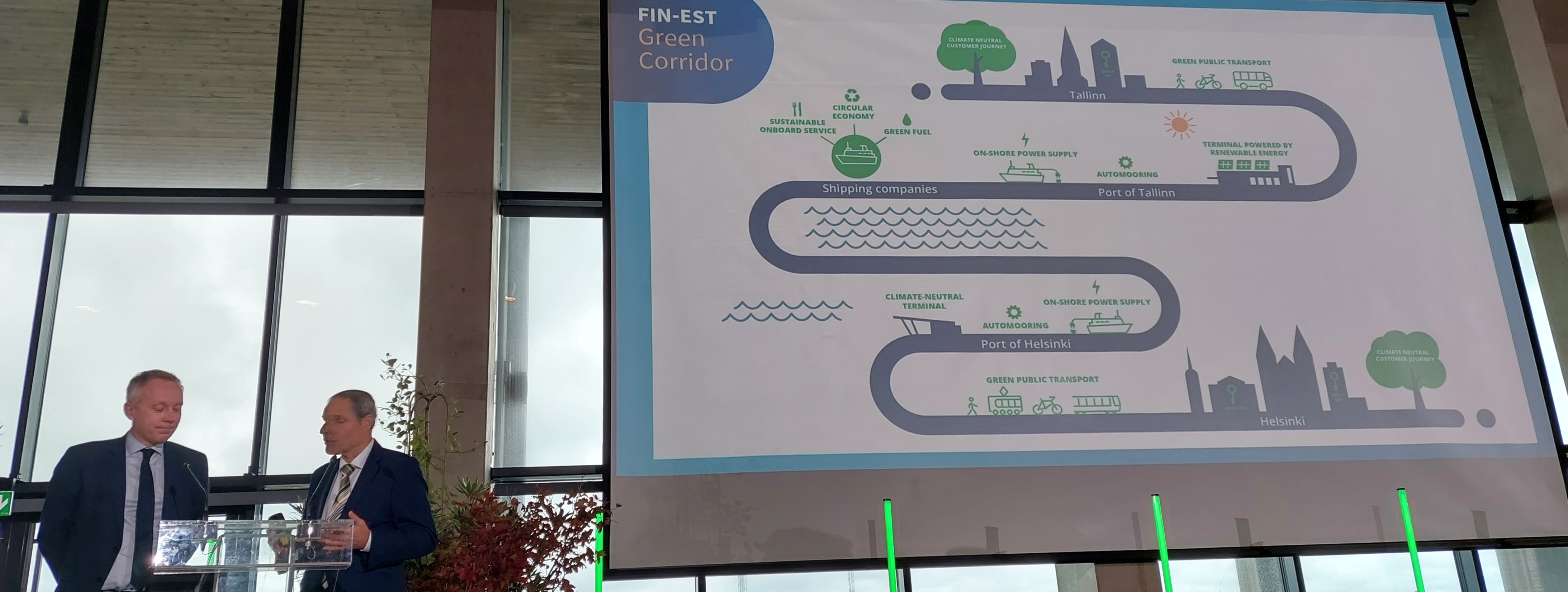
“FIN-EST Green Corridor – stands out from other projects, among other things, because in addition to the ports, all three passenger-car ferry companies and cities are part of it.”
On Monday, October 9, the ports and cities of Helsinki and Tallinn, and three shipping companies Tallink, Viking Line and Eckerö, signed the FIN-EST Green Corridor Memorandum of Understanding, the aim of which is to create an environmentally friendly maritime traffic corridor for passenger and cargo customers between Helsinki and Tallinn, as well as Vuosaari and Muuga.
What is the Green Corridor?
In November 2021, 24 countries signed the Clydebank Declaration in Copenhagen, committing to establish partnerships with ports and shipping companies to accelerate decarbonisation of the maritime sector and its fuel supply through Green Corridor projects. In addition, the countries, among other things, will identify and support regulation and incentives to remove obstacles to Green Corridors.
In two years, at least 22 green corridors have already been announced around the world, e.g. Shanghai – Los Angeles, Dover – Calais and Turku – Stockholm. And more announcements are coming.
The Green Corridor between Helsinki and Tallinn differs from other projects in that, in addition to the ports, it is being created by all three passenger car ferry companies and the cities around the ports. In practice, the work has started years ago, when both ports have started calculating their own emissions and created an environmental strategy for themselves. Now calculations will be combined and joint goals are created together with partners.
Learning and practical actions together
The IMO and the EU have determined that shipping will become carbon neutral by the middle of this century. However, shipping, like other business activities, is above all a competition for customers and cargo. Some of the shipping companies’ customers are ready to pay more for low-emission shipping, but the number of these customers is still small. An important question for the maritime industry is how to transition to emission-free operations in an economically sustainable way. The schedule is tight, now it’s time to rush.
The FIN-EST green corridor creates a common basis for this transition. It can be described as follows:
1. Measuring. Common emission measurement methods will be created and the effects of the operation will be monitored. All the companies in this green corridor already have their environmental calculations, but they use different principles and calculation methods.
2. Efficiency development and technological developments. A large part of reducing shipping emissions is operational improvement measures. In recent years, especially with the TwinPort project co-financed by the EU, a lot of efficiency measures have been carried out in the ports of Helsinki and Tallinn, which have streamlined traffic, reduced waiting times and reduced emissions. Examples include shore power, solar panels and automatic mooring systems, which can reduce required port time. In this way, driving speeds and at the same time emissions can be decreased during the sea journey.
3. New alternative carbon-neutral fuels. It is estimated that the promotion of efficiency and the technological measures described above will already reduce the greenhouse gas emissions of maritime transport by one third of the current level. However, it is necessary to prepare for the next stage, i.e. completely carbon-neutral fuels.
In the green transition, there constant discussion that the investments cannot be made before it is known what will be the zero-emission fuel that will be used. In the worst case, the ships running the same line will all switch to different new fuels and it will be expensive or even impossible for the ports to serve them.
The most important benefit of the Green Corridor, in addition to reducing emissions, is the development of common knowledge and expertise. When we see the situation, the possibilities and the effects together, we can agree on common operating models and development, and apply for financial support for actions and influence the regulatory system as needed. The most important investment at the moment is the development of competence, so that all companies participating in the corridor have the same, best possible information in use.
The phrase “This is the only way forward” was heard at the opening ceremony of the FIN-EST green corridor. In order for this one of the world’s busiest and most efficient shipping lines to be able to switch to emission-free operation and at the same time maintain efficiency and attractiveness from the customers’ point of view, this work must be done together by learning and developing operations.
The article was previously published in Navigator Magazine in Finnish, an online magazine for maritime professionals, on October 10, 2023.


