The EU is tightening requirements for ports. Finland has twice the required port capacity, and the tonnage handled by ports is not increasing. The need for security of supply does not imply that more port capacity is needed either. Are some ports about to be shut down?
The EU offers a carrot and a stick for port development
The construction of the TEN-T network is at the heart of the European Union’s transport policy. Its aim is to enable the safe and sustainable movement of goods and people and to create seamless transport connections with neighbouring countries.
As part of this network, the EU has defined so-called transport corridors and their nodes, the development of which is financially supported. In Finland, the EU usually finances around 20–30 percent of the costs of projects, provided that they meet complex criteria regarding the maturity of the project, socio-economic benefit, impact and quality of the plan. In Estonia, the support can reach up to 85 percent.
However, the funding provided by the EU is not free. Ports are divided into two categories: so-called core network ports and comprehensive network ports.
By 2030, core network ports must have, among other things, connections to rail and road infrastructure and, where possible, to inland waterways. They must also offer at least one multimodal freight terminal. Ports must also be prepared for the distribution of alternative fuels, the reception of waste from ships and digital infrastructure.
These are all significant development projects that require both expertise and financial resources. Comprehensive network ports have the same requirements, but their deadline is by 2050.
The ports of Finland and Estonia are largely very small. In Finland, only five ports are part of the core network (the ports of HaminaKotka, Helsinki, Oulu, Turku and Naantali) and 13 are part of the comprehensive network (Eckerö, Hanko, Inkoo, Joensuu, Kaskinen, Kemi, Kokkola, Lappeenranta, Mariehamn, Pori, Rauma, Raahe and Tornio). Estonia has only one core network port, the Port of Tallinn, and seven ports of the comprehensive network.
The biggest challenges are therefore faced by the ports of the core network, but on the other hand, larger ports have more resources to develop their customer service, efficiency, IT systems, alternative fuel supply and hinterland connections. This allows them to compete for customers and cover the economically required investments.
Port capacity twice as much as needed
The volume of goods passing through Finnish ports has not increased recently. In 2024, the total volume of sea transport was 85 million tonnes. The last time it was at this low a level was in 2009. According to statistics, 15 ports handle over 95 percent of Finnish maritime traffic, and less than 5 percent of traffic passes through other ports.
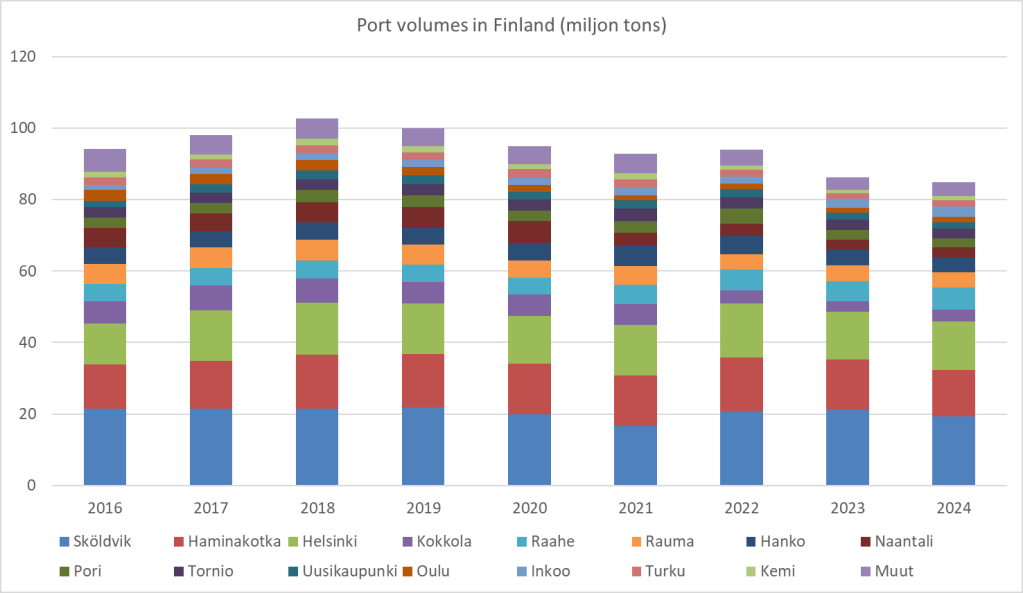
Figure 1. Tonnage handled by Finnish ports (2016–2024). Source: Statistics Finland
The situation is similar in Estonia. In 2011, 45 million tons passed through Estonian ports. In 2023, the amount had dropped to 21 million tons. Today, there is very much extra port capacity in Estonia.
However, ports are very different. Some serve only local industry, while others serve the entire country or, in the past, even transit traffic from other countries. Port services can be aimed at passengers, container traffic, rubber-wheel transport, solid cargo or dry bulk cargo.
The National Security Agency published a report a month ago, according to which Finland has twice as much port capacity as needed. However, the surplus varies significantly depending on the type of cargo. The most excess capacity is in so-called break bulk cargo and ro-ro traffic, and the least in liquid bulk cargo.
Of the individual factors, the port capacity is most limited by the availability of storage facilities (especially warm storage facilities), railcar and locomotive capacity, and fixed port cranes.
On the other hand, if a significant crisis situation arises in the Baltic Sea that prevents current shipping, protected sea routes may only be maintained in a few ports. Therefore, security of supply alone cannot justify a larger port capacity than currently exists.
Challenges for ports
How will ports cope with the increasingly strict obligations imposed by the EU and customers, while at the same time cargo volumes are decreasing? Do all current ports have a chance of succeeding in this competition, where volumes are not growing, capacity is already twice as high as needed, and at the same time the requirements placed on ports are becoming stricter? Not all ports can claim security of supply.
Are we facing fierce competition between ports or a government-driven shutdown of ports in order to reduce the costs of maintaining sea and hinterland connections?
The article was previously published in Navigator Magazine, an online magazine for maritime professionals, on March 17, 2025.

 Tales of Talsinki